LoRA Fine-Tuning Stable Diffusion: Mechanics for Custom NSFW Models
Table of Contents
How LoRA Fine-Tuning Stable Diffusion Opened Up Custom NSFW Workflows
I spent three frustrating days trying to customize a Stable Diffusion model for a very specific body type and pose last year. The full fine-tuning approach kept crashing my GPU and erasing everything the base model knew about lighting and composition. Then I tried LoRA fine-tuning Stable Diffusion instead. As of May 2026 the technique still dominates because it freezes the original weights and adds only tiny trainable matrices. Analyses from late 2025 show it cuts trainable parameters by more than 99 percent. Training that once took days now finishes in under two hours on a single RTX 4090. Creators finally get hyper-specific faces, bodies, and erotic poses without destroying the model's general knowledge.
The Simple Math That Makes LoRA So Efficient
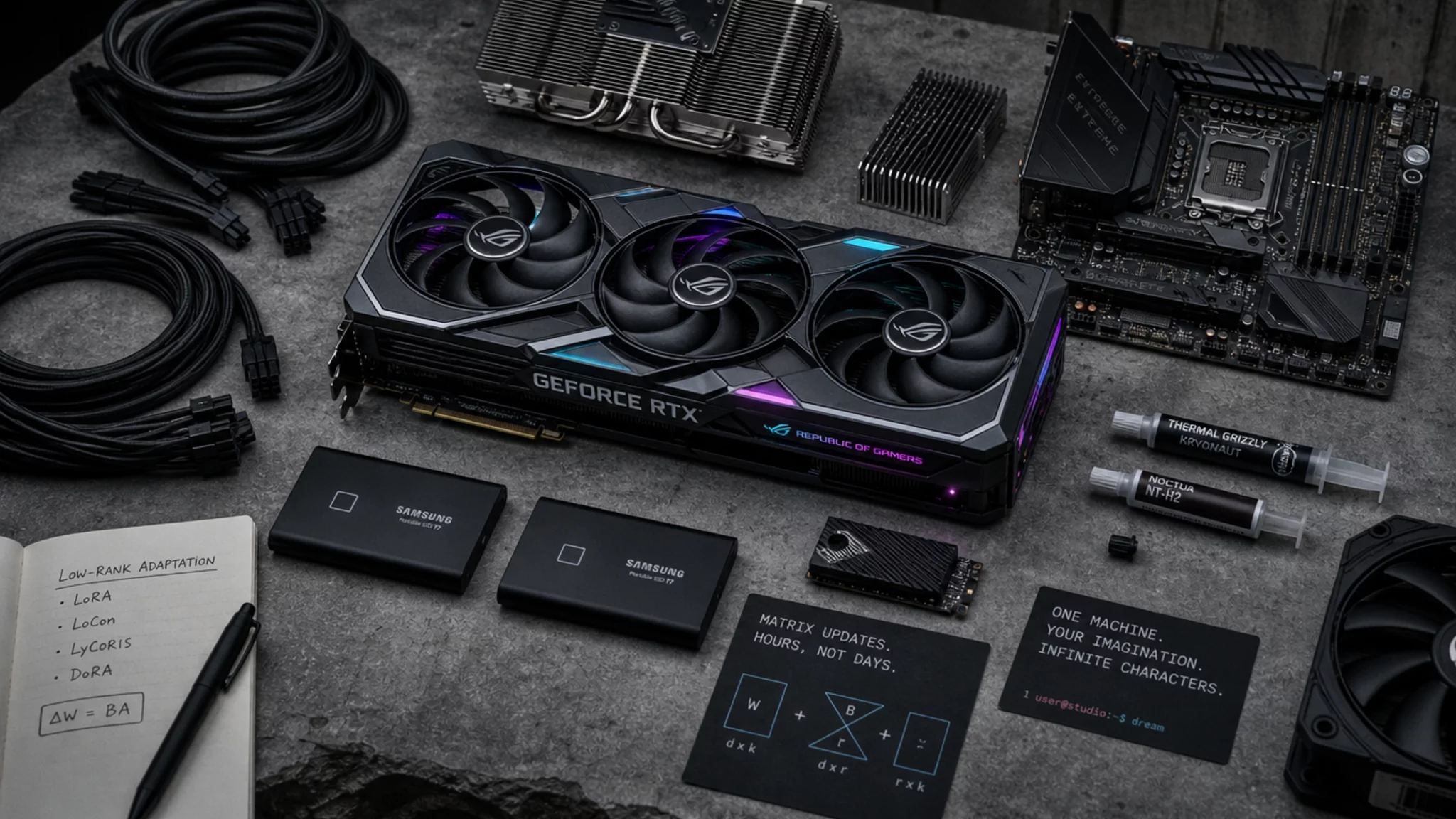
The core idea is elegant. Instead of updating an entire weight matrix W, LoRA approximates the change as the product of two much smaller matrices: ΔW = BA. B is tall and skinny, A is short and wide, and their rank r stays deliberately small—often between 8 and 64. This low-rank trick works surprisingly well for diffusion models because most of the important updates live in a low-dimensional subspace. Alpha scales the output so the adapter doesn't overpower the frozen base. The result feels almost magical: you train a fraction of the parameters yet still capture fine details like a particular curve of the hip or the drape of lace lingerie.
Film it on AiExotic
LoRA fine-tuning Stable Diffusion: Custom NSFW Models in Hours
Make this fantasy nowWhere LoRA Actually Sits Inside Stable Diffusion
LoRA modules slot into the cross-attention layers of the U-Net and the text encoder. That placement matters. These layers control how text prompts translate into visual features, so a well-trained LoRA sharpens prompt adherence for very specific erotic scenes without touching the rest of the network. Because the base weights stay frozen, the model keeps its broad understanding of anatomy, lighting, and composition. You can ask for "a woman in that exact pose wearing only an open silk robe" and the adapter handles the custom details while the foundation model supplies everything else. The separation is what makes combining several LoRAs later feel natural rather than chaotic.
A Practical Workflow for Training Custom NSFW LoRAs
Start with 10–30 carefully chosen images of the exact body type, pose, or outfit you want. Crop consistently, caption them with the specific details you care about, and feed the set into Kohya_ss. Typical settings for adult content include rank 32, alpha 32, and a learning rate around 1e-4. Most trainings wrap up in 60–90 minutes on a 4090. Once you have several LoRAs—one for a face, one for a pose, one for lingerie—you can load them together at different strengths. LoRA’s ability to deliver precise, low-cost customizations directly into the diffusion process is precisely what enables the hyper-realistic, performer-specific adult images and video frames generated on modern AI platforms. LoRA fine-tuning Stable Diffusion: Custom NSFW Models in Hours shows exactly how these adapters scale to full scenes.
Film it on AiExotic
LoRA fine-tuning Stable Diffusion: Custom NSFW Models in Hours
Make this fantasy nowQuestions Creators Ask About LoRA for Adult Content
What rank and alpha settings work best for face LoRAs versus full-body adult models?
Faces usually need lower rank, around 8–16 with alpha equal to rank, to keep identity sharp without artifacts. Full-body or complex pose LoRAs benefit from rank 32–64 so the model captures clothing folds and limb positioning accurately.
How long does training a custom NSFW LoRA typically take?
On an RTX 4090, a focused 20-image set finishes in 60 to 120 minutes. Larger datasets or higher ranks push training toward three hours, but the process stays practical on consumer hardware.
How can I prevent overfitting when training on limited NSFW image datasets?
Use augmentation like random cropping and color shifts, keep training steps modest, and add a small amount of noise to captions. Stop early if the model starts repeating the same background or lighting instead of generalizing the desired feature.
Is it safe to merge multiple LoRAs together for complex scenes?
Yes, but merge at reduced weights—0.6 to 0.8 per adapter—to avoid conflicts. Test combinations on a few prompts first. Most creators merge face and pose LoRAs successfully this way without retraining.
How compatible are LoRA models with current Stable Diffusion pipelines in 2026?
Extremely compatible. Nearly every modern interface and pipeline loads LoRAs natively. They work alongside ControlNets, IP-Adapter, and newer schedulers without special conversion steps.
What's the difference between LoRA and full fine-tuning for diffusion models?
Full fine-tuning updates every weight and can destroy the base model's knowledge while requiring days of compute. LoRA updates only a tiny fraction, preserves the original capabilities, and delivers usable custom NSFW models in hours instead.
Create Your Own AI Porn Video
Turn any fantasy into a realistic Full HD video. 1,000+ scenarios, positions & kinks — 100% private.
Start Creating NowAbout the Author
Digital Artist & AI Tool Reviewer
Digital artist & AI tool tester. Breaks workflows so you don't have to. Writes the guides she wishes existed.